The galleries will be temporarily closed starting Monday, October 5, for the installation of our new exhibition.


 Carrington Ware: Home Spun
Presented as a vibrant series of autobiographical textile flags, Home Spun draws on deep nostalgia to reflect on artist Carrington Ware’s identity, youth, and Southern upbringing. From the quiet rhythm of snapping peas on the porch with her grandmother to the lively energy of neighborhood fishing carnivals, Ware captures both the passing down of family traditions and the joyful spaces where community and childhood intersect. The installation pays homage to fond memories of her life in Georgia while honoring the collective love, intentionality, and effort required to cultivate a joyful upbringing.
Through Home Spun, Ware invites online and in-person visitors alike to pause and reconnect with the warmth of their own personal histories—memories deeply rooted in family, community, and care.
Carrington Ware (b. 1993) is a multidisciplinary artist working with illustration, video, sound, textiles, and installation. Employing various mediums, Ware sustains an explorative practice grounded in play and curiosity. Her work is underpinned by Black narratives and storytelling, with a focus on nostalgia, identity, and place.
Ware received her MFA from Florida International University in 2020 and her BFA from Valdosta State University in 2015. Currently, Ware is based between South Florida and North Georgia. Selected solo exhibitions include Soft (2023), Tunnel Projects, and Leisure (2021), Miami Beach Urban Studios, Miami, Florida. Selected group exhibitions include Tunnel Annex + Miami Design District, Meditations On Waking Up (2024), The Frank Gallery, Voices of Experience: Invited Artists’ Works (2024), The Arc, Evidence of Contrary Instincts (2024), The Lowe Museum, Banned!: Story Tellers (2024), Museum of Contemporary Art North Miami, 2022 South Florida Consortium (2023), and Stoveworks, Y’all Don’t Hear Me: The Black Appalachia (2023).
SFCC Artist Series: Ecology and Environment with Mark Delmont, Luke Jenkins and Amanda LinaresThe Museum of Contemporary Art, North Miami, invites you to experience its South Florida Cultural Consortium exhibition through artist-led group tours, offered on select dates and times each month. These intimate walkthroughs pair participating artists with curators, offering visitors a deeper, more personal understanding of the work on view. Grounded in dialogue and firsthand perspective, each tour opens new pathways into the exhibition, shaped by the artists’ own insights, processes, and lived connections to the work.
Tour 1: Ecology and Environment with Mark Delmont, Luke Jenkins, and Amanda Linares
Co-curators Kimari Jackson and Laura Novoa present a tour featuring artists Mark Delmont, Luke Jenkins and Amanda Linares, whose practices converge in their treatment of Florida’s ecology as both subject and collaborator. Each artist approaches the natural world through a different temporal register, yet together they propose a shared understanding of place as cyclical, animate, and continually remade.
Mark Delmont’s diptych of twin figures safeguarding the swamp opens this conversation through ancestry, stewardship, and the human responsibility to landscapes that have provided sustenance, both physical and spiritual, over generations.
Suspended above the gallery, Luke Jenkins’ lamp, with surfaces carved with termite forms, picks up that same sense of continuity from the opposite end, evoking the gradual processes of erosion and consumption that quietly sustain natural systems beyond human intervention.
Amanda Linares carries these concerns inward, constructing a fragmented domestic landscape in which tile, concrete, and detailed graphite drawings of botanical forms blur the threshold between the built environment and nature, suggesting that the outside world is already present within the architecture of daily life.
Collectively, these works encourage visitors to perceive place not as a mere backdrop, but as a living presence: generative, vulnerable, and deeply intertwined with the histories of those who inhabit it.
Spring 2026 Exhibitions ReceptionYou're invited! On April 15, join us in celebrating our spring exhibitions: MOCA's Collection Focus: Anchors of Light, South Florida Cultural Consortium, Teen Art Force: Antithesis, and Joan Jiménez “Entes”: Bailando Nuestros Problemas.
Reception Details
Date: Wednesday, April 15, 2026
Teen Art Force | 5:30 - 6:30 PM
Reception | 6:30 - 8:30 PM
Admission I $10
Free for MOCA Members and North Miami Residents
We hope to see you at MOCA on April 15!
Teen Art Force: AntithesisAntithesis
an· tith· e· sis
a figure of speech in which opposing or contrasting ideas are placed in parallel, allowing their differences to sharpen meaning.
In this exhibition, the MOCA’s Teen Art Force student artists present works that initially appear to contrast, or even oppose, one another. Different materials, perspectives, and visual languages sit side by side. Yet it is precisely within this tension that something generative emerges. Each artwork gains its power not in isolation, but through dialogue with the others: Antithesis offers unity through opposition.
Just as contrast in a photograph deepens a composition and brings it into focus, the differences within this exhibition illuminate the strengths of each individual artist. Painting speaks to sculpture. Abstraction challenges realism. Quiet gestures sit beside bold declarations. Together, they form a dynamic and evolving whole.
In a culture that often prioritizes individual needs over collective care, Antithesis asks us to reflect on how we exist together. Community is not built on sameness, but through variation, dialogue, and mutual growth. These young artists remind us that difference can be not a barrier, but a powerful foundation for connection.
The Teen Art Force program at Museum of Contemporary Art North Miami (MOCA) is a free, after-school, multidisciplinary arts program for teens ages 13–17, designed to provide both artistic training and exposure to professional art environments. The program is one of the museum’s most sustained community-facing initiatives and has been serving young people in North Miami for 30 years, positioning it as a long-standing investment in local youth and creative development.
Permanent Collection Focus: Anchors of Light Anchors of Light celebrates the thirtieth anniversary of the Museum of Contemporary Art North Miami by honoring three decades of artistic risk, community-rooted vision, and institutional firsts that helped define contemporary art in Miami. In a region defined by relentless sun, migration, and constant reinvention, Anchors of Light reflects on MOCA’s role as both ballast and beacon over the past thirty years—anchoring artists at pivotal moments while illuminating the cultural ecosystems that have grown beneath Miami’s climate of exposure and possibility. Founded in 1995 in a historically under-resourced neighborhood, MOCA emerged before the city’s global art boom, committing early to artists whose practices were experimental, diasporic, and often under-recognized.
The exhibition unfolds across three thematic environments: The Body, The Garden, and The Miami School, titles emerging instinctively from the collection itself. Together, they reflect MOCA’s history of collecting through curiosity, material experimentation, and conceptual rigor, prioritizing artistic inquiry and artists whose practices often resist the pressures of capital and convention. In sum, Anchors of Light proposes a continuum between Miami artists and canonical lineages, framing the museum as a node where Minimalism, Conceptual, Pop, Performance, Feminist, and Caribbean diasporic aesthetics converge to generate new perspectives. The exhibition allows objects to exist in organic conversation with one another, like relics unearthed by a metal detector on an abandoned island, or faces gathered in a school class photograph with no center, no margins.
For this anniversary, canonical blue-chip names are not cordoned off from artists who spent their careers in survival mode. Local life appears through assemblage, diagram, ritual, collage, and constructed narrative, carried forward through thirty years of exhibitions, gifts, and acquisitions as a living record of Miami becoming. This exhibition asks how artists, past and present, have anchored themselves within a city defined by arrival, visibility, and reinvention, and how the museum carries these stories forward. This anniversary stands as both reflection and affirmation, honoring those who have shaped its history and future while sustaining the conditions that continue to ground and illuminate Miami’s rich, diverse, and defiant creative landscape.
Anchors of Light is presented in part with support from the MOCA Curator’s Circle Visionaries.
Image credit:
ALFREDO JAAR. A Logo for America, 1995 / Collection of the Museum of Contemporary Art, North Miami
Installation photos: Zachary Balber
South Florida Cultural Consortium (SFCC)
This year’s South Florida Cultural Consortium exhibition presents fourteen artists and one artist collaborative working across textile, painting, ceramic, photographic, sculptural, and time-based media. Each artist’s practice investigates the formation of identity through processes of accumulation, translation, and transformation, revealing how personal histories intersect with broader cultural and ecological narratives.
Opening with Nina Surel’s Demeter, Birth of Florida, a reimagining of the state through a generative divine feminine and closing with Lauren Shapiro’s Storm at Sea and Onajide Shabaka’s Poiesis Jaguar, both of which reflect on humanity’s relationship to the natural order, the exhibition resists a linear framework. Instead, it proposes a cyclical understanding of time, wherein memory, identity, and place are continually negotiated and reshaped.
Across this arc, the artists engage with thresholds, transitional spaces, and shifting geographies as sites of emergence, transformation, and interdependence. The works presented situate themselves comfortably within the unknown, embodying a continuum through which ideas and histories are carried forward, reimagined, and brought into being again and again.
Established in 1988, The South Florida Cultural Consortium is a regional initiative in support of the arts, governed by an Interlocal Agreement among the counties of Broward, Martin, Miami-Dade, Monroe, and Palm Beach. The Consortium’s members are the local arts agencies of these five counties, including the Broward County Cultural Division, the Arts Council of Martin County, the Miami-Dade County Department of Cultural Affairs, the Florida Keys Council of the Arts, and the Cultural Council for Palm Beach County.
The Consortium works to foster cooperation across the South Florida region to help develop and promote the work of cultural organizations and artists and the audiences that they serve. Its programs and services range from the Visual and Media Artists Grant Program to regional arts education and cultural tourism cooperative ventures. Each year, more than 300 artists who live and work throughout the five counties, submit their applications for consideration to the South Florida Cultural Consortium’s Grant Program for Visual and Media Artists.
Regional and national panels comprised of experts in visual art, film, and media from a variety of academic and major visual arts institutions are given the responsibility of recommending the final recipients. The South Florida Cultural Consortium is one of the most successful regional arts alliances in the nation, demonstrating that by sharing resources and best practices, the arts can thrive across a burgeoning five-county area.
The South Florida Cultural Consortium is made possible with major support from the Miami-Dade County Department of Cultural Affairs and the Cultural Affairs Council, the Miami-Dade County Mayor and Board of County Commissioners, and the Boards of County Commissioners of The Broward County Cultural Division, The Cultural Council for Palm Beach County, The Arts Council of Martin County, and the Florida Keys Council of the Arts.
Artists interested in learning about grant opportunities through the South Florida Cultural Consortium should visit Miami-Dade County Department of Cultural Affairs, Art in Public Places.
.png)
Ashlee Thomas
Chair, South Florida Cultural Consortium
Interim Director, Miami-Dade County Department of Cultural Affairs
Philip Dunlap
Director, Broward Cultural Division
Elizabeth S. Young
Executive Director, Florida Keys Council of the Arts
Dave Lawrence
President and CEO, Cultural Council for Palm Beach County
Nancy Turrell
Executive Director, The Arts Council, Martin County
Amanda Sanfilippo Long
Director, South Florida Cultural Consortium
The Miami-Dade County Department of Cultural Affairs and the Cultural Affairs Council develop cultural excellence, diversity, access and participation throughout Miami-Dade County by strategically creating and promoting equitable opportunities for artists and cultural organizations, and our residents and visitors who are their audiences. Through staff, board and programmatic resources, the Department, the Council and the Trust promote, coordinate and support Miami-Dade County’s more than 1,000 nonprofit cultural organizations as well as thousands of resident artists through grants, technical assistance, public information and interactive community planning. The Department directs the Art in Public Places program and serves its board, the Art in Public Places Trust, commissioning, curating, maintaining and promoting the County’s art collection. The Department also manages, programs and operates the African Heritage Cultural Arts Center, Dennis C. Moss Cultural Arts Center, Joseph Caleb Auditorium, and Miami-Dade County Auditorium, all dedicated to presenting and supporting excellence in the arts for the entire community. The Department receives funding through the Miami-Dade County Mayor and Board of County Commissioners, The Children’s Trust, the National Endowment for the Arts, the State of Florida through the Florida Department of State, Florida Division of Arts and Culture and the Florida Council on Arts and Culture, the John S. and James L. Knight Foundation, the Peacock Foundation, Inc., The Jorge M. Pérez Family Foundation at The Miami Foundation, and the Taft Foundation. Other support and services are provided by TicketWeb for the Culture Shock Miami program, the Greater Miami Convention and Visitors Bureau, the South Florida Cultural Consortium and the Tourist Development Council.
Tayina Deravile
Director of Programming I Girls' Club (Broward County)
Gabino A. Castelán
Artist
SFCC Grantee Alumnae (Palm Beach County)
Tola Porter
Ph.D, Museum Educator for Academic and Public Programs Lowe Art Museum | University of Miami (Miami-Dade County)
Laura Novoa
Former Assistant Director of Programs + Community Engagement, Bakehouse Art Complex (Miami-Dade County)
Lauren Baccus
Director of Education, MOCA North Miami, (Miami-Dade County)
Sarah Cartwright
Chief Curator and Ulla R. Searing Curator of Collections, The Ringling Museum of Art, Sarasota, FL
Jazmine Catasus
Artistic Director / Master Printer, The Elizabeth Foundation for the Arts, New York, NY
Jasper A. Sanchez
Assistant Curator, Boston Public Art Triennial, Boston, MA.
Hero Image Credit:
MANUELA GONZÁLEZ. Luz de Luna, 2025
Installation photos: Zachary Balber
Joan Jiménez “Entes”: Bailando Nuestros ProblemasBailando Nuestros Problemas by Joan Jiménez “Entes” draws inspiration from the everyday life of Miami’s Little Havana community. The installation reflects the ways people gather—through conversation, dance, and shared stories—to build and sustain cultural life. Cut in iron as a tribute to Shango of the Yoruba pantheon, a figure closely tied to the spiritual and cultural heritage of the African diaspora in Latin America, the work transforms memory into a series of sculptural altars.
Through these forms, Jiménez reflects on both the joy and the challenges embedded in the migrant experience of Black and Brown communities across Latin America. He describes these moments as marroneo—collective choreographies of racialized bodies moving through and reclaiming public space. In Jiménez’s work, these gestures become acts of joy and resistance that honor cultural continuity and imagine new futures.
About the artist
Joan Jiménez “Entes” is a Peruvian artist living between Lima and Miami, whose work is rooted in the lived realities, memories, and cultural energies of the street, or barrio. A graduate of Escuela Superior De Bellas Artes Corriente Alterna in Plastic Arts, Jiménez’s multidisciplinary practice spans painting, sculpture, printmaking, and urban interventions. His work celebrates Latin American and Afro-descendant communities, reflecting on migration, collective resilience, and the emotional landscapes that define neighborhood life. For over twenty-five years, Jiménez has engaged the city as both a site of creation and a source of knowledge. His early practice in graffiti and muralism shaped his understanding of public space as a space of dialogue in an open arena where identity, belonging, and social tension become visible. In Lima, Peru, Jiménez has exhibited at the L’imaginaire Gallery, Inca Garcilaso Cultural Center, Espacio Venancio Shinki and Circuito Mágico del Agua.
Photos by Daniel Bock
Artist headshot by Rey Londres
Hiba Schahbaz: The Gardenḥum ko maʿlūm hai jannat kī ḥaqīqat lekin
dil ke ḳhush rakhne ko ‘ġhālib’ ye ḳhayāl achchhā hai
- Ustad Mirza Ghalib, Mid-19th Century
I know the reality of paradise, but
To keep the heart happy, Ghalib, this thought is pleasant.
- Ustad Mirza Ghalib, Mid-19th Century
Spanning over fifteen years, Hiba Schahbaz: The Garden is the first major retrospective of Pakistani-American artist Hiba Schahbaz. The exhibition brings together motifs that recur throughout Schahbaz’s visual lexicon: global allegory, a direct feminist gaze, and fantastical beings that traverse elemental realms of earth, fire, wind, sky, and sea, alongside human architectural interventions. Collectively, this selection of paintings forms an environment that invites viewers into the artist’s expansive, imagined worlds.
The exhibition is framed conceptually through the idea of the jannat, or “Paradise Garden”—an idyllic space referenced in Islamic tradition and Sufi poetry across the Middle East and South Asia. While rooted in these traditions, the Paradise Garden is a framework that echoes across cultures and spiritual practices. Gardens as sites of refuge, abundance, and transcendence are a global phenomenon, and these resonances are woven into Schahbaz’s practice through her evolving visual vocabulary.
The curatorial layout draws inspiration from the Persian and Mughal char-bagh, a quadrilateral garden divided by water channels with a central fountain. These sixteenth- and seventeenth-century landscapes embodied harmony, spirituality, and transcendence. Within The Garden, this structure becomes a poetic framework, echoing Schahbaz’s language of multiplicity and transformation. It is important to note that the works were not created to fit this scheme; rather, the char-bagh is a curatorial concept that provides a lens for navigating the artist’s fluid and expansive practice.
Beyond historical references, the exhibition also reflects the lush landscapes and gardening culture of South Florida. The devotion to cultivating flora and community in Miami—particularly within immigrant and diasporic communities of color—parallels traditions of care and collective tending that are prevalent across South Asia.
Born in Karachi and trained in Lahore, Schahbaz studied Indo-Persian miniature painting, a centuries-old discipline marked by precision, ornamentation, and narrative depth. This foundation continues to inform her practice, as she reimagines aesthetic and cultural inheritances through a contemporary, feminist lens.
The Garden invites viewers into a living terrain where myth, history, and imagination intertwine, offering new visions of femme subjectivity taking root and flourishing.
Hiba Schahbaz: The Garden is curated by Jasmine Wahi.
Installation images by Zachary Balber
Diana Eusebio: Field of DreamsDiana Eusebio: Field of Dreams is the South Florida-based artist’s reimagining of what it means to build and preserve a sense of home. Drawing from her Afro-Dominican and Indigenous Quechua Peruvian heritage, Eusebio uses natural dyes and textiles to tell stories about memory, migration, and belonging. This first solo museum exhibition features hand-dyed fabrics and digital works that pay tribute to those places the artist calls home: the Dominican Republic, Peru, and Miami, Florida. Field of Dreams reminds us of ancestral traditions and celebrates nature and wisdom passed down through generations.
The exhibition takes its title from the 1989 baseball film which focuses on themes of faith, belief, and second chances. For Eusebio, this title reflects the Dominican immigrant experience: the act of building a new home in a new land.
Field of Dreams takes the viewer on a historical journey. Eusebio creates a variation of vibrant colors found in the natural world throughout the Americas and the Caribbean, with a palette that incorporates seven dyes: avocados and cochineal (cochinilla) for red and pinks; annatto (bija), Spanish moss (itla-okla), and marigolds for yellows and oranges; Palo de Campeche (logwood) for purple; and indigo for blue. These seven core dyes are central to her practice, connecting her work to centuries-old dyeing traditions, from harvesting to boiling the plants and immersing the fabric within the dyes.
This exhibition transforms the gallery into an ethnobotanical garden of art, filled with suspended Spanish moss and soft muhly grass, family portraits communicatively representing layered memories. Visitors are invited to move through this living environment that celebrates heritage, community, and the enduring bond between people and the natural world.
Diana Eusebio: Field of Dreams is curated by Kimari Jackson
Photo of Diana Eusebio by Bryan Tinoco
Magnus Sodamin: Gateway (between the sun and moon)Gateway (between the sun and moon) is a site-specific installation, part of an ongoing series by Magnus Sodamin titled Reflections of Florida Wild.
Gateway extends above MOCA’s pond and is a whimsical representation of Florida’s wildlife, engaging viewers in a reflection on the fragility and vulnerability of our natural environment. Guests are invited to step closer for a deeper look at the silhouettes of indigenous animals and plants vital to Florida’s ecosystem, including the Florida panther, the flamingo, the osprey, the owl, the deer, mangroves and saw palm. The warm pink tones of Gateway are intentionally chosen to contrast against the turquoise sky, allowing for deeper connection and meditation on the natural beauty of our Floridian world.
About the artist
Born in Manhattan, New York (1987) Sodamin lives and works in Miami. He spent a year developing his painting practice in Lillehammer, Norway at the Nansenskolen, a humanitarian institute that focuses on cross-cultural exchange. He received his BFA in painting with a minor in art history from the New World School of the Arts, Miami in 2012. Sodamin explores practices ranging from painting, textile, ceramic and drawing. Selected solo shows include "Wild Altar" (Dot Fifty-One Gallery, 2021), "Impressions of Our Landscape" (Primary Projects, 2017), and "Infinity Split" (Primary Projects, 2015). Residencies include Agder Kunst Center, Norway (2020), Vermont Studio Center (2018), Airie, Everglades(2017), Museums Quartier, Vienna (2015) and Deering Estate in Miami, Florida (2015). His work resides in both the Boca Raton Museum of Art and Jorge M. Pérez Collection.
Vickie Pierre: The Maiden is The Warrior Vickie Pierre: The Maiden is The Warrior is the first solo exhibition by Brooklyn-born, South Florida-based artist Vickie Pierre. Curated by Adeze Wilford, the Blackmon Perry Curator of African American Art & Art of the African Diaspora at the Memphis Brooks Museum of Art, the exhibition opens on April 30, 2025.
Pierre’s artistic practice is a vivid exploration of memory, transformation, and identity, rooted in her Haitian heritage and the material culture that surrounds her. The Maiden is The Warrior presents more than 40 works—spanning paper collages, paintings, and immersive installations—that collectively reflect Pierre’s innovative use of found objects and her fluid approach to abstraction and figuration.
Central to the exhibition is Pierre’s Poupées in the Bush series of collages, nodding to surrealists like Louise Bourgeois and Hans Bellmer, along with artists from Art Deco, Art Nouveau, and Pattern & Decoration movements, such as Miriam Shapiro. A key highlight in the exhibition, this body of work features hybridized figures inspired by Greek and global mythology through latticed paper collages as gestures of femininity and armor. This body of work embodies rebirth and reclamation, personified through the Black female form and diverse identities, from South and East Asian to Caribbean, European, African, Indigenous, and Middle Eastern cultures. Collage is integral to Pierre’s practice, emphasizing rhythmic layering to create figures from various source materials. Her works transcend time, blending historical and pop-cultural references as a vehicle for empowerment.
A new installation will serve as the exhibition’s centerpiece, evoking a carousel or chandelier within an imagined garden. Motorized ceiling elements shimmer with beads, casting a wavering cathedral effect. Hand-strung beading is a key aspect of Pierre’s artistic language, incorporating glass, crystal, wood, acrylic, metal, and Majok seeds (“Job’s Tears”). This meditative process of stringing beads becomes an act of recording and reflection, and by incorporating these elements into her installation, Pierre honors her Haitian heritage while also underscoring the interconnected nature of cultural practices and traditions.
Cascading from this moving ceiling ornament, strands refract light in a soft, shimmering shower, forming a gathering space for Pierre’s Poupées to commune and assemble. In addition, the installation will feature various other decorative floating objects—including suspended butterflies, chime bells, and floral bundles—symbolizing the magical, yet fleeting, cycle of life, enlightenment, and the preservation of beauty and memories.
By incorporating both deeply personal and diasporic narratives, The Maiden is The Warrior invites viewers into a meditative, transformative space where ornamentation meets the unsettling, asserting a profound exploration of memory, resilience, and cultural interconnectivity.
About the artist
Vickie Pierre is a native New Yorker, born and raised in Brooklyn, New York. There, the artist graduated from the School of Visual Arts with a degree in Fine Arts Painting. After living in Miami for 20+ years, she relocated to live and create in Vero Beach, Florida. Her artworks have been displayed in solo and group exhibitions nationally and internationally, including Perez Art Museum Miami, the National Museum of Women in the Arts, Washington, D.C., and the Museum of Contemporary Art of Puerto Rico, among others. In 2023, Pierre's work was selected by the Art in Embassies Program to be displayed in the U.S. Embassy in Prague, Czechoslovakia. Her artworks can be found in private and public collections.
Artist photo: Courtesy of the artist
About the curator
Adeze Wilford is the Blackmon Perry Curator of African-American Art and Art of the African Diaspora at the Memphis Brooks Museum of Art. She previously was the Curator at The Museum of Contemporary Art, North Miami where she led the museum’s public art initiatives and organized exhibitions including Andrea Chung: Between Too Late and Too Early and Lonnie Holley: If You Really Knew. Prior to that she was an Assistant Curator at The Shed where she organized Howardena Pindell: Rope/Fire/Water. She was an inaugural joint curatorial fellow at The Studio Museum in Harlem and the Museum of Modern Art. She organized Vernacular Interior at Hales Gallery in 2019 as well as Excerpt (2017) at the Studio Museum and Black Intimacy (2017) a film series at MoMA. She has contributed scholarship to various catalogues and magazines including Young, Gifted and Black and Black Refractions. She graduated from Northwestern University with a BA in Art History and African-American Studies.
Teen Art Force: BloomBloom is an interconnected web of ideas and artistic expressions embodied by the entire Teen Art Force cohort, extending beyond a singular concept. For over 20 years, The Museum of Contemporary Art, North Miami has been pivotal in bringing local, like-minded teen artists in conversation through its annual Teen Art Force Exhibition. Bloom continues to honor that deep-rooted tradition. It is a celebration of these young and gifted artists’ own blossoming.
The exhibition spans a variety of works, from still-life to abstract multi-media pieces, highlighting the artists’ diverse array of practices and inspirations throughout the year. For these students, renewal and the satisfaction of a new beginning is motivation for creation. Entire worlds bloom from their pencils and paintbrushes, birthing people, places and colors, poured onto canvases like tidal waves of inspiration.
Philip Smith: Magnetic FieldsPhilip Smith: Magnetic Fields is a career survey and solo institutional debut for Miami artist Philip Smith. Curated by art historian Robin Clark, Magnetic Fields presents over 50 works spanning five decades of Smith’s expansive artistic career.
The exhibition unfolds across six gallery spaces at MOCA, with thematically organized environments that revolve entirely around Smith’s multifaceted pictographic language. Extending beyond conventional artistic practices, Smith explores metaphysical and spiritual themes through large-scale, vibrantly chromatic paintings.
Smith’s work traverses a spectrum of influences—from a childhood imbued with mystical and spiritual healing to ancient pictographs—creating a tapestry of personal and collective memory. Iconography derived from biology texts, diagrams, and Cold War spy manuals coexist in his compositions, offering not only a visual feast but also an energetic, intellectual dialogue.
At MOCA, the exhibition traces Smith’s artistic evolution. Early works from the Pictures era showcase his ambitiously-scaled drawings based on found images forming enigmatic, puzzle-like compositions. Another section, “Black Paintings,” draws from his studies of ancient cultures and mystery schools, and then into “Modern Paintings,” which overlay linear patterns with abstract geometries inspired by mid-century painters like Barnett Newman, Mark Tobey, and Jasper Johns.
The latter half of Smith’s career is represented through“ Color Paintings”, which feature crisp graphic imagery carved into bold, monochromatic fields, and “White Paintings” works, where erasures evoke both disappearance and emergence.
The exhibition culminates in Smith’s newest series, “Energy Paintings,” in which monumental canvases are uniquely activated with gestural and chromatic energy. These works synthesize elements from earlier series, radiating a fresh dynamism. Much like the earth’s magnetic field—generated by molten iron at its core and shielding the planet from harmful solar radiation—Smith’s “Energy Paintings” emit their own magnetism. Vibrant lines and cosmological symbols pulse across the canvases, drawing viewers into their powerful, protective embrace.
Philip Smith: Magnetic Fields will remain on view through October 5, 2025.
About the artist
Philip Smith (b. Miami, FL, 1952) is based in Miami. In his work, found images documented by Smith on slide film are used to create metaphysical narratives that explore new areas of consciousness. Art historical references, DNA strands, periodic tables, tarot cards, Cold War spy manuals, advertisements for home goods, and cartoon characters populate his imagery which is both cryptic and personal. While much of his earlier work seems mysteriously encoded, the most recent paintings convey a sense of openness and dynamism. They may be understood as generators of positive energy, or magnetic fields. Smith’s work has been collected by major museums including the Moderna Museet in Stockholm, the Whitney Museum, the Houston Museum of Fine Arts, the Museum of Contemporary Art in San Diego, the Detroit Institute of Arts and the Perez Art Museum Miami. He is the author of a memoir, Walking Through Walls(Simon and Schuster, 2008).
Artist photo credit: Oriol Tarridas
About the curator
Robin Clark is a program director, curator, and educator focused on the imbrications of contemporary art, architecture, and the environment from a global perspective. She has held curatorial positions at the Museum of Contemporary Art, Los Angeles; the Solomon R. Guggenheim Museum; the Saint Louis Art Museum; the Pulitzer Arts Foundation; and the Museum of Contemporary Art San Diego. She led the Artist Initiative collection research program at the San Francisco Museum of Modern Art, where she also launched the museum’s first higher education program teaching from collections. Until recently a scholar in residence at the University of California, Berkeley, she currently manages the Parker Foundation art collection loan program in San Francisco, and is a contributor to the Josef Albers catalogue raisonné of paintings forthcoming from Yale University Press.
Avi Young: Bearing BondsAvi Young is a queer Afro-Latinx artist whose work reflects their vibrant cultural heritage and passion for storytelling. Their practice explores the semiotic relationships between materials, often centering the human figure in tender portrayals of marginalized communities. Through textured, intimate narratives, their work celebrates identity, fosters empathy, and highlights the power of connection. Bearing Bonds depicts the silhouettes of two figures, the adolescent and the mentor extending their arms towards each other but unable to reach one another. This installation serves as a visual metaphor for the different challenges of connection as an effect of physical distance, systemic divides, or emotional barriers. By bridging the silhouettes together with melodic chimes, the artist symbolically creates connections and communication.
About the Artist
Avi Young is a graduate of the Design and Architecture Senior High where they balanced art and STEM studies, including marine biology research at the Frost Science Museum. Young honed their craft at the Kansas City Art Institute, focusing on ceramics and material exploration. Since 2021, they have been an associate artist at the Bakehouse Art Complex, contributing to Miami’s dynamic creative community.
Avi Young
Bearing bonds, 2025
Waterjet cut aluminum, aircraft cable, ceramic chimes
Smita Sen: EmbodiedAndrea Chung: Between Too Late and Too EarlyManuel Mathieu: World Discovered Under Other Skies | Dwelling on the InvisibleCollection Focus: Light PlayArt on the Plaza: Chris Friday’s NarcissistArtist Chris Friday’s Narcissist is a large-scale, free-standing metal figure that appears to be captivated by its own reflection in the waters of the Museum's fountain, seemingly oblivious to the gaze of onlookers. Narcissist symbolizes Black art that is concerned with itself; celebrating its own inherent beauty and essence, without exposing deeper emotions or meanings, especially when placed in a public contemporary art space.
FROM THE CURATOR
Using a style the artist calls “chalkboard” Chris Friday creates large scale drawings that consider Black figures in moments of leisure, play and slumber. Desiring to reimagine how the Black body is engaged within the context of display in institutional spaces, she creates moments that range from joyful to tender. Finding that Black art has historically been focused on how the viewer thinks or what they can be taught, in Narcissist Friday positions a work and a subject that is wholly self-absorbed. Draped across the Museum’s pond, the figure is both a study of introspection and a call to action. Following the artist’s long history of word play, the work’s title seeks to take the negative connotations of narcissism and spins it as an intentional and necessary part of self-reflection that are vital to emotional growth and self-care. Narcissist encourages the kind of selfishness that is necessary during times of rest and restoration. Often women and especially Black women take on excess tasks at work and in the home exerting emotional energy that leaves one depleted. With this work, a stark contrast to that notion, Friday creates an oversized visual beacon for one to take up space and rest.
ABOUT THE ARTIST
Chris Friday is a multidisciplinary artist based in Miami, Fl, whose work offers itself as both a contemplative reflection of and counter-narrative to the pervasive under/misrepresentations of Blackness in mainstream media and popular culture. Her portfolio features large-scale works on paper, murals, video, ceramics, projections, photography, comic illustrations, and social practice/activism through curating.
Friday’s work has been included in exhibitions locally, nationally and internationally. Recent exhibitions include solos “Good Times” curated by Laura Novoa and presented at Oolite Arts, (2023), “One More River”, presented at Austin Peay State University in Clarksville, Tennessee and group show “The Cartography Project” presented by the Kennedy Center in Washington, D.C. (2022).
The artist has received numerous awards, fellowships and grants, including a Knight Foundation “Knights Champion” grant (2022) , a “The Ellies” Creator award from Oolite Arts (2021), The GMBCV People's Choice award in Miami Beach's No Vacancy juried art show (2021) and residencies with MassMoCA (2023), Anderson Ranch Arts Center (2022), and the Visual Arts Residency at Chautauqua Institute (2019).
Chris Friday is currently a resident studio artist at Oolite Arts in Miami, Florida and an adjunct professor at the New World School of the Arts.
Juan Francisco Elso: Por AméricaJamea Richmond-Edwards: Ancient FutureSterling Rook’s Almost HomeMultidisciplinary artist Sterling Rook has been creating structures that explore the concept of home as it relates to both a physical space and one of cultural memory. In Almost Home the artist mines the personal, including references in color palate to his childhood homes and his multiethnic heritage, Rook has created an immersive sculpture that invites the viewer to cross a threshold and recontextualize a dwelling. Comprised of rebar, a ubiquitous material that is a familiar sight across construction sites throughout Miami, the artist meticulously attaches various species of palm fronds to the structure in seamless blending of traditional and modern building materials, natural and fabricated objects, and European and indigenous monuments. His largest palm frond structure to date, Almost Home leads viewers on a journey through time, culture and nostalgia as they navigate through the work. Once again recalling specificity of place the sculpture is painted a familiar vibrant pink hue that is common throughout homes in South Florida and the Caribbean. Using a variety of palms that are familiar to communities in Miami, Rook interweaves coconut, foxtail and queen palms among others, which are not native to the area to highlight the idea of the concept of a paradise created beyond its natural form. In this way Almost Home becomes the hybrid the artist is interested in interrogating and the hybrid we all are comfortable navigating.
About the Artist:
Sterling Rook is a Miami native with Masters in Fine Art from Florida International University. He works out of his studio at the Bakehouse Art Complex in Miami, Florida. Rook’s work uses his skills in metalwork and fabric to further expand the language of sculpture and fiber-art. Forged and welded steel, painted palm fronds, and handmade rope from used clothing, all factor in for Rook in as avenues expanding this visual vocabulary. This visual-vocabulary is enriched through working within a family legacy of fiber-crafts: On the maternal/Peruvian side of his family, his grandmother was a re-weaver, and his grandfather was a tailor. His paternal/British grandfather’s last name was “Stringer,” which is a British historical-occupational name for one who made rope or string. Rook uses these as beacons to explore art-making as both a generative and regenerative process, which is like tapestry that interprets and combines histories in the creation of an artwork. Using these markers as a compass, his work bridges gaps within disparate cultural heritages connecting past to present.
South Florida Cultural Consortium (SFCC) 2023Lonnie Holley: If You Really KnewLeah Gordon: KanavalDidier William: Nou Kite Tout Sa DèyèUnder the Electric TreeThe Museum of Contemporary Art, North Miami is pleased to announce a series of public activations, “Under the Electric Tree” at Griffing Park. Programming will include site-specific performances, live music, hands-on art activities, and more, in conjunction with the recently restored public artwork "Electric Tree" by international renowned artist, Mark Handforth.
“Electric Tree” was first installed just blocks away from MOCA at Griffing Park in 2011, in conjunction with the artist’s major exhibition “Rolling Stop” at the museum. The 2021 restoration of this significant public artwork was made possible with major support from the John S. and James L. Knight Foundation and the City of North Miami and is one of the most important public artworks that MOCA has commissioned in its 25-year history. Handforth’s sculpture traces the branches of a 100-foot-wide banyan tree with brilliantly colored fluorescent tubes that illuminate its understory. The restoration of “Electric Tree” offers arts and culture to a community park that is open year-round.
Handforth graduated from the Academy of Fine Art in Frankfurt and the Slade School of Fine Art in London. He is internationally acclaimed for his large-scale installations in public spaces including Central Park in New York, the Dallas Museum of Art, and the MCA in Chicago, as well as during the FIAC offsite event in Paris. Handforth has also received public commissions from the cities of Paris (Porte de Bagnolet) and Zurich (Tessinerplatz).
“The stunning ‘Electric Tree’ at Griffing Park in North Miami is one of the most important permanent
public artworks that the museum has commissioned. We are proud to activate the park with consistent programming for all ages at the center of our community,” said Chana Sheldon, executive director of the Museum of Contemporary Art, North Miami. “The initiative launched in April with a concert by Lang Cook Live and Brother Dan of Terrestrial Funk. MOCA welcomed guests as well as food trucks and local vendors. It was a great night! We are deeply grateful for support of the Knight Foundation and the City of North Miami for this initiative.”
“Mark Handforth's 'Electric Tree’ is an innovative and stunning work. I love that Mark has created a way for us to experience the banyan tree 24/7 through his light painting. The ability of artists to interpret the world around them in new ways is endlessly fascinating, and especially so when used to create art that is easily accessible to the public,” said Victoria Rogers, vice president of Knight Foundation’s arts program. “That MOCA's new programming will connect visual art to great live performances by local talent is a great way to showcase the power of the arts to connect us to each other and to place.”
Located at 12220 Griffing Boulevard, North Miami, FL 33161, the full lineup of programming includes:
The Mento Philharmonic OrchestraSaturday, June 11, 7 p.m.

In celebration of Caribbean Heritage Month, MOCA North Miami is proud to feature The Mento Philharmonic Orchestra. Mento is a style of Jamaican folk music that predates and has greatly influenced Ska and Reggae music. Mento typically features acoustic instruments, such as acoustic guitar, banjo, hand drums, and the rhumba box (which is a large mbira in the shape of a box that can be sat on while played.) The rhumba box carries the bass part of the music.Tallawah Mento Band is a Florida-based Jamaican Mento Band founded with four of the original members of the Jamaica Folk Revue. Tallawah adds its particular flavor to the music of several genres, including the music of Haiti, Cuba, Trinidad and many loved hits from the 50’s and 60’s. With the addition of internationally acclaimed jazz guitarist Keith Stoddart, formerly of the Jamaican Jazz Band “The Sonny Bradshaw Seven,” the band has extended its repertoire to include old jazz, classical, popular, and soca/calypso. The group has entertained all over the USA, and recently in Jamaica, and has won numerous accolades. They have also been featured on NBC 6 Television, Radio Waves, Mystic Radio, and Radio WOKB 1600, in Orlando.RSVP HerePioneer Winter in Celebration of Pride MonthWednesday, June 29, 7:30 p.m.

Choreographer Pioneer Winter and sound artist Juraj Kojs will collaborate with performers and community members on a Pride Month activation at the Electric Tree. Collected oral histories and elder stories of 'first prides' will become an interactive soundscape for dancers to embody themes of memory, resilience, and community –reflecting on the Electric Tree created by artist Mark Handforth as a meeting place for corporeal and social exchange.Pioneer Winter is a Miami-based choreographer and artistic director of Pioneer Winter Collective, an intergenerational and physically integrated dance-theater company, rooted in social practice and community, queer visibility and beauty beyond the mainstream. Recognized in Dance Magazine's 25 to Watch, Pioneer Winter's work democratizes performance in public spaces, museums and galleries, stage, and film. Juraj Kojs's (he/him) commissions for acoustic, electroacoustic, multimedia and installation pieces include Meet the Composer, Harvestworks New York, Vizcaya Museum and Gardens, Deering Estate, Miami Light Project and Miami Theater Center. His works have received multiple awards in Europe and he currently directs Foundation for Emerging Technologies and Arts (FETA) and teaches at the University of Miami's Frost School of Music.RSVP Here
ART ON THE PLAZA - Celebrating Najja Moon: Active ReflectionsMOCA North Miami is celebrating the artist Najja Moon. In her work “Reading Reflections,” Moon explores themes of reflection and self-empowerment through a human-scale intervention on MOCA's Plaza. Led by Moon, participants will draw on rolls of canvas around the installation using black markers to add their own symbols and reflections on life, memories, poetry, hopes and dreams.Guests can also enjoy a block party, an opportunity to meet the artist, food trucks, and free lemonade. Join Vinyl Social Club, a Miami-based collective of music lovers, vinyl collectors, and DJ's of all skill levels for an open-spin format party where attendees are encouraged to bring their records and sign up for a 30-minute set. Guests are invited to stay for Jazz at MOCA, the monthly free community jazz concert. MOCA Members can register for a free drink ticket and 10% food discount.Art on the Plaza is presented by MOCA, with Major Support from the North Miami Community Redevelopment Agency (NMCRA).
Postcards from the EdgeCurrently on view at MOCA North Miami Nov. 17, 2021 – October 2, 2022 - Postcard from the Edge: A Dispatch of Hope, a selection of images made by Iris PhotoCollective photojournalists and associates while on assignment around the world. These images serve as confirmations of human resilience and strength. Curated by Carl Juste.
Postcard from the Edge:A Dispatch of Hope
In the early 1900s, during the golden age of postcards, newspaper stories were typically published without accompanying images. A new class of photographers emerged to fill the gap: postcard photographers who documented major public events much as photojournalists do today. Postcards became the fastest and cheapest way to send news out of town, as well as more personal reports of places visited.As a global correspondent for over thirty years, I have borne witness to the weight of being human in locations all over this planet. Photojournalists are present in challenging and painful circumstances: natural disasters, war, famine, and social injustice. We often find ourselves perched on an edge, not knowing how we will return intact from an experience. As a photojournalist, even when documenting human beings at their worst, I always feel it is important to search for redemptive images beyond the messages of the headlines.In 1999, I cofounded Iris Photo Collective (IPC), assembling photojournalists who document the relationship between people of color and the world. Their work counteracts the images of violence, poverty, and suffering that dominate mainstream media portrayals of Black lives. Postcard from the Edge: A Dispatch of Hope is a selection of twenty images made by Iris PhotoCollective photojournalists and associates while on assignment around the world. For this presentation at MOCA, I have chosen five images that represent the larger group and serve as confirmations of human resilience and strength. These images were made in situations of extreme suffering, yet both the photographers and subjects were able to extract from them moments of peace, power, and joy. These may not be the images that were published in the news, yet each is a small match in a dark room.- Carl Juste
My Name Is MaryanMy Name Is Maryan, a traveling exhibition organized by Alison Gingeras, was the first retrospective to examine every period of Maryan’s life and work, situating his figurative “truth-painting” within postwar art and his experience as a Holocaust survivor.
My Name is MaryanAfter the Rain Comes Light: Portraits of Resilience Stephen Arboite and Morel DoucetCollection Focus: Our Beginnings Never Know Our EndsMichael Richards: Are You Down?Life and Spirituality in Haitian ArtNovember 18, 2020 - March 14, 2021
Curated by Francine Birbragher-Rozencwaig
Influenced by an island whose history is cultivated with elements from African, American Indigenous, and European culture, the masters featured in this exhibition range from self-taught artists to academically trained painters.The merging of techniques, methods, and cultures is seen through their work, ushering forth a style that is uniquely and quintessentially Haitian. The paintings explore the Haitian identity through deep, rich, vibrant colored scenes depicting historical figures, tropical flowers and fruits, rural landscapes, and daily activities infused with spirituality and Afro-Caribbean religious symbolism, particularly from a Vodou tradition.
This exhibition marks the first time these paintings, which belong to a private collection, have been shown together. It features works by Hector Hyppolite, Philomé Obin, Wilson Bigaud, Jacques-Enguérrand Gourgue, and Gérard Valcin, renowned masters from the first and second generation of artists associated with Port-au-Prince’s Centre d’Art. The exhibition also includes some of their contemporaries and pupils, including Ernst Louizor, Célestin Faustin, Adam Leontus, Diodonné Cédor, and Laurent Casimir.

Hector Hyppolite
Une jeune dame, n.d.
Mixed media on wood
Betty and Isaac Rudman Trust Collection
Raúl De Nieves: Eternal Return & The Obsidian HeartCurated by Risa Puleo
Eternal Return and The Obsidian Heart is, to date, the most comprehensive survey of work by Raúl de Nieves. The exhibition connects the artist’s exuberant material sensibility to his roots in punk music, devotional ritual, and celebratory queerness. The symbiosis between de Nieves’s sculptural work and musical collaborations, including his band Hairbone as well as his operatic performances, had yet to be considered until this exhibition.
De Nieves investigates divinity, desire, and decadence across material, emotional, and spiritual realms. The artist draws inspiration from his childhood spent in Michoacán, Mexico, where public religious ceremonies and private rituals incorporate elaborate costuming and theatrical components. Coming of age in DIY scenes in San Diego and San Francisco also energized de Nieves with a theatrical approach to art making. After arriving in New York in 2007, the artist began working collaboratively on musical projects that transgress genre boundaries into artistic performances. Collaborating with a largely queer milieu of artists, dancers, and musicians, he fronts the noise band Hairbone and has orchestrated a number of operas. Examples of both types of performances play throughout the exhibition to illuminate the symbiosis between de Nieves’s solo sculptural work and his musical collaborations.
In New York, de Nieves also began to articulate his aesthetic of abundance through an economy of means by producing labor-intensive paintings, sculptures, drawings, installations, and environments. The artist transmutes emotional and psychic energy into physical form through a ritual-like process. To create his elaborate anthropomorphic figures, the artist channels emotions through his body into readymade, material containers that include craft store beads, crystals, plastic jewels, sequins, cardboard, transparent acetate, and tape. From afar, these materials shimmer and seduce, but reveal themselves to be mass-produced and readily available upon a closer look. This meticulous process is the means by which de Nieves imbues his opulent creations with a spiritual essence and power. Such otherworldly power is felt throughout the exhibition and embodied in the artist’s signature “stained glass” installations and multi-genre performances that channel alternate dimensions.
To step into this exhibition is to enter into an awareness of the multiplicity of time. The artist and curator worked closely together to design the exhibition as an immersive Gesamtkunstwerk (total artwork) in which individual sculptures, installations, and audio from performances blend together into a cohesive experience of the spiritual, familial, and self across time. In the “stained glass” installation, Basilio, cosmic time is represented in colorful configurations of planets moving around the sun, which is itself depicted as it appears from Earth at various moments of transit across the sky over the course of a year. The time of a year—measured by the cycle of the four seasons—is also represented in the series of paintings, Fall, Winter, Spring, and Summer. This cycle of birth, death, and rebirth repeats throughout the exhibition. Human time—measured in the progression from infancy through adolescence, to adulthood, and into old age—manifests in the myriad gem-encrusted babies who dance between installations. Death and rebirth appear as one concept in the deconstructed sculptural installation Celebration. At the center of the exhibition, a life-size carousel circles endlessly in a performance of fantasy and delirium, referencing the cyclical time of Eternal Return: the idea that time is composed of a limited number of events that endlessly recur in different sequences and combinations.
The time of Eternal Return is populated by archetypes like the Fool, the first card in the tarot, and Saint George, the dragon slayer from medieval lore. Both characters reoccur in de Nieves’s work as they symbolize key moments in life’s unfolding journey. Ancestral time is accessed through objects like obsidian, a central metaphor in the exhibition. The volcanic stone was used by the Olmec and Mexica people of ancient Mexico to make mirrors that also functioned as spiritual portals. Dark and shining—much like the black glass used in the installation Fina—one must look through obsidian’s reflectivity to shift the mirror reflection into a portal for communicating with ancestors.
For de Nieves, art making is a related process of creating a mirror for one’s self; a tool for reflection and a means of externalizing an interior state in order to see possibilities for growth. Eternal Return and The Obsidian Heart offers a holistic look at the ways in which the artist rejoins the spiritual with the material within a contemporary culture that is as familiar as it is magical.
–Risa Puleo, Curator
Image: Raúl de Nieves / Fina Wisdom, 2019 / Vintage military suit, sequins, metal bells, threads, glue, cardboard, plastic beads, tape, trims, mannequin / Dimensions variable / Collection of Steve Corkin and Dan Maddalena
Raul de Nieves: Eternal Return and the Obsidian Heart is made possible with the continued support of the North Miami Mayor and Council and the City of North Miami, the State of Florida, Department of State, Division of Cultural Affairs and the Florida Council on Arts and Culture, the Miami-Dade County Department of Cultural Affairs and the Cultural Affairs Council, the Miami-Dade County Mayor and Board of County Commissioners, and with support from the Green Family Foundation. Additional support from Company Gallery, Michael Ringier and Fitzpatrick Gallery is gratefully acknowledged.
RAÚL DE NIEVES is a multimedia artist, performer, and musician, whose wide-ranging practice investigates notions of beauty and transformation. De Nieves’ visual symbolism draws on both classical Catholic and Mexican vernacular motifs to create his own unique mythology, which often challenges and explores themes of sexuality, the human body, and individual and public histories. Recent solo exhibitions include those at the Cleveland Museum of Art, Cleveland; Company, New York; Apalazzo, Brescia and Freedman Fitzpatrick, Los Angeles. Additional group shows include those at K11 Art Foundation, Hong Kong; Swiss Institute, New York; New Orleans Museum of Art, New Orleans; The Museum of Art and Design, New York; the Zabludowicz Collection, London as well the 2017 Whitney Biennial and MoMA PS1’s 2015 Greater New York. De Nieves has performed at Documenta 14, Performa 13, MoMA PS1, ICA Philadelphia, The Watermill Center, The Kitchen, Artist’s Space and numerous other venues. Forthcoming solo exhibitions include those at Company, New York; and ICA, Boston. His work is included in public collections at the Whitney Museum of American Art and the Museum of Contemporary Art, Los Angeles. De Nieves was born in 1983 in Michoacan, Mexico and currently lives and works in Brooklyn, NY.
RISA PULEO is an independent curator and critic. Her exhibition Monarchs: Brown and Native Contemporary Artists in the Path of the Butterfly, was curated for Bemis Center for Contemporary Art during her year as curator-in-residence. The exhibition traveled to the Museum of Contemporary Art, North Miami; Blue Star Contemporary and Southwest School of Art in San Antonio; and The Nerman Art Museum in Overland Park, Kansas. Puleo’s exhibition Walls Turned Sideways: Artists Confront the Justice System opened at the Contemporary Arts Museum in Houston in 2018 and traveled to Tufts University Art Gallery in 2020. Other exhibitions have been hosted by the Leslie Lohman Museum in New York City; Franklin Street Works in Stamford, CT; Charlotte Street Foundation in Kansas City, and more. She was a guest curator of Artpace San Antonio’s International Artist-in-Residence Spring 2018 cycle: Rafa Esparza, Kapwani Kiwanga, and Carlos Rosales-Silva. Puleo has master’s degrees from the Center for Curatorial Studies at Bard College and Hunter College and is a doctoral candidate in Northwestern University’s art history program. She has written for Art in America, Art Papers, Art 21, Asia Art Pacific, Hyperallergic.com, Modern Painters and other art publications.
Read the extended object labels
Miami and the Beaches: RAÚL DE NIEVES EXHIBITION AT MIAMI MUSEUM OF CONTEMPORARY ART
Modern Luxury’s MIAMI Magazine: Spring Awakening. Page 51
Raúl de Nieves: Eternal Return and The Obsidian HeartRaúl de Nieves: Eternal Return and The Obsidian Heart, an exhibition organized by Risa Puleo, was the most comprehensive survey of de Nieves’s work to date, connecting his exuberant material practice to punk music, devotional ritual, celebratory queerness, and operatic performance.
Virtual Exhibition: Corporal DADEVirtual ReceptionFriday, May 29th / 7–8pm
Corporal Dade
Exhibition ViewingMay 29th – August 31st, 2020Interdisciplinary Miami artists present Corporal DADE, a virtual exploration of Miami-Dade County’s dynamic makeup. Corporal DADE highlights the people and animals that cohabitate in shared spaces throughout our multifaceted community prior to COVID-19. The art exhibited was created during the artists’ tenure as part of ProjectArt’s residency where they teach, mentor youth, and create art in 8 Miami-Dade Public Libraries. Corporal or “Body” in Spanish is especially relevant during this time of social distancing, where we take a moment to highlight this body of work, reminding us of the importance of community and connection.ProjectArt Resident Artists: Aurora Molina, Almaz Wilson, Laura Prada, Lucia Del Sanchez, Mateo Nava, Mateo Serna Zapata, Sonia Báez Hernández, and Susan Feliciano will present and talk about their contemporary artwork they created during their residency.ProjectArt’s Miami program is offered in 8 Miami-Dade Public Libraries including Culmer/Overtown, Hispanic Branch, Kendall Branch, Model City, and is supported by the Miami-Dade County Dept. of Cultural Affairs, The Kleh Family Foundation, The Miami Foundation, The Kirk Foundation, The Batchelor Foundation, Cornelia T. Bailey, Ocean Reef Community Foundation, and more. MOCA has partnered with ProjectArt since 2017, by providing local artists the space and support to present their work
ProjectArt empowers youth, emerging artists, and communities through partnerships with public libraries in 8 cities from coast to coast. ProjectArt’s resident artists teach tuition-free, after-school art classes to children in divested areas while developing new artwork in library workspaces. While in-person art classes at the libraries are paused, our resident artists continue to be paid, and we are providing lessons to our students online.
 projectart: Digital Imprint
ProjectArt Miami & NOLA Resident Artist Exhibition x Museum of Contemporary Art, North Miami
Exhibition on view May 28 – Aug. 31, 2021
Interdisciplinary Miami and New Orleans’ Artists present Digital Imprint, a collection of works focusing on creating connections and capturing traces of daily life through the lens of a continually rising virtual sphere. The art exhibited was created during the artists’ tenure as part of ProjectArt’s residency where they teach, mentor youth, and create art in partnership with the Miami-Dade Public Library and the New Orleans Public Library. Digital Imprint is a reflection of the technological spaces we’ve been inhabiting for the last year and the power of creative expression that lives beyond the screen.ProjectArt Miami & NOLA’s annual resident exhibition, Digital Imprint, will take place virtually on Thursday, May 27th. ProjectArt Resident Artists, Aurora Molina, Alexander Zastera, MILAGROS, Sonia Báez Hernández, and Susan Feliciano will present and talk about their contemporary artwork they created during their residency. Digital Imprint will be live streamed on projectart.org and on view for the Summer of 2021 on mocanomi.org. The event is free and open to the public with advanced reserved tickets.ProjectArt’s Miami program is offered in partnership with the Miami-Dade Public Libraries and is supported by the Miami-Dade County Dept. of Cultural Affairs, The Kleh Family Foundation, The Miami Foundation, The Kirk Foundation, The Batchelor Foundation, Cornelia T. Bailey, and more. Since 2017, our ongoing partnership with MOCA has allowed our program to thrive by providing local artists the space and support to present their work in a distinguished institution.Mayor Carlos Gimenez has praised the nonprofit’s partnership with the Miami-Dade Public Library System, saying that “teaching arts to children in our neighborhoods enhances their quality of life by providing them with invaluable opportunities to learn, grow, and excel. Once again, this collaboration proves that libraries in the 21st century can provide the kind of programs and services that make our neighborhoods great places to live and raise families.”

Aurora Molina was born in La Havana, Cuba, in 1984. She emigrated to the United States at the age of sixteen, where she opted to pursue an education in fine art. Molina received her Associates of Arts in Visual Arts from Miami Dade College, a Bachelors in Fine Arts specializing in Mixed Media from Florida International University and Master Degree in Contemporary Art at the Universidad Europea de Madrid completed in 2009.Alexander Zastera is known for their dark mystical paintings, found object installation and public performance centered around the environment. Zastera graduated with a BFA in Studio art and BA in art history from Florida State University. Based in Miami Beach, Florida, working as an artist, activist, and educator they use their studio work and interest in public education to address local ecological issues.MILAGROS, co-founders Felici Asteinza and Joey Fillastre, along with their ever-changing cast of collaborators, create site-specific works that explore the history of place through striking arrangements of color and mark. With an exuberant style that champions the hand made and the intuitive, MILAGROS energizes public spaces with effervescent patterns that obliterate the seams between structures and highlight the unique attributes of the surrounding architecture.Sonia Báez Hernández is contemporary Afro-Caribbean artist, curator, and educator. She employs an interdisciplinary multidisciplinary methodology in her artistic practices. Her artwork promotes a dialogue about police brutality, immigration, violence against women, climate justice, breast cancer, health disparity, biomedicine, and human rights.Susan Feliciano is a Miami-based interdisciplinary artist who works in painting, photography, poetry, installation, and textiles. A New York native, daughter of Colombian and Puerto Rican parents, her work explores psychological and physical spaces, the emotional force of color, and the beauty of impermanence.
Corporal Dade2018 Resident Exhibition
ProjectArt empowers youth, emerging artists, and communities through partnerships with public libraries in 9 cities from coast to coast. ProjectArt’s resident artists teach tuition-free, after-school art classes to children in partnership with Public Libraries. While in-person art classes at the libraries are paused, we are providing the residency for artists and lessons to our students online. Current programs include:● Artist studio tours and discussions with Jen Stark, Katherine Bernhardt, the Haas Brothers and more on social media at @projectartusa● ProjectArt At Home -ProjectArt continues its mission by providing short-form, art making lessons that can be accessed by anyone at home.● Resident Artist Monthly Talks● Virtual ExhibitionsSocial MediaFacebook, Instagram, Twitter: @projectartusaEXHIBITION CONTACTProjectArt Miami Director & Southeast Regional Director of Impact Sandra Portal-Andreusandra@projectart.org954-559-4564
HamacaS: A Project by Liene BosquêSaturday, February 8 through Sunday, March 29, 2020
The Museum of Contemporary Art North Miami (MOCA) is presenting HamacaS, a socially engaged project by Liene Bosquê, coordinated by Ana Clara Silva, on view from February 8 through March 29, 2020. HamacaS explores the cultural dissonance and emotional displacement experienced by immigrants in the United States. The project consists of an interactive installation at the museum that will be activated through collective hammock weaving sessions and workshops. The project will offer a critical and expansive conversation around immigration with communities in Miami. As an integral part of the project, HamacaS will continue to develop and be presented throughout different locations in Miami after its inaugural run at MOCA North Miami.
HamacaS reconsiders the relational meaning of site and place for a group of people that both occupy several spaces at once and are rendered invisible in this country. The project asks us to imagine how immigrants carry place with them across borders and barriers. What purpose can a collective, shared space have for members of a community that is both villainized and erased at the same time? HamacaS is meant to act as a safe space for dialogue, debate, and understanding through engaging in making––the space between the hand and the mind that offers respite.
Liene Bosquê is a visual artist and art educator based in Miami. Bosquê’s artworks have been exhibited in museums and galleries in the United States, at MoMA PS1 in New York, and the Museum of Contemporary Photography in Chicago, among other places. In 2016, she received the Emerging Artist Fellowship from the Socrates Sculpture Park in Queens, where she presented her first public sculpture. Recently, Bosquê was an artist in residence at Queens Museum’s ArtBuilt residency in New York, where she started the socially engaged project, HamacaS. Her work has been included in international exhibitions in Brazil, Portugal, Italy, Turkey, and South Korea; at places such as Museu de Historia Natural in Lisbon, Museu de Arte de Ribeirão Preto, and Sesc in São Paulo.
HamacaS is funded by The Ellies, Miami’s visual arts awards, presented by Oolite Arts as well as the WaveMaker Grants program presented by Locust Projects, and is supported by The55project.
The project will maintain public hours on Saturdays and Sundays from 2:00 – 4:00 p.m. during which the artist will be present, and will be open to anyone that would like to drop in and participate. The artist will not be onsite on Feb. 22, Feb. 23, March 14, March 15, March 28, and March 29 however the project will remain on view.
Cecilia Vicuña: About to HappenAlice Rahon: Poetic InvocationsAlice Rahon: Poetic Invocations, an exhibition organized by Tere Arcq, surveyed the French-Mexican Surrealist’s work while advancing scholarship on underrecognized women artists and the Indigenous and intercultural influences on European artists exiled in the Americas.
South Florida Cultural Consortium 2019South Florida Cultural Consortium, an exhibition organized by Amy Galpin, brought together grant-winning artists from Broward, Martin-Monroe, Palm Beach, and Miami-Dade counties to showcase the region’s diverse and innovative practices.
Collection Focus: Works on Paper from the 1960s-1980sCollection Focus: Works on Paper from the 1960s–1980s, a collection-based exhibition organized by Elizabeth Shannon, launched MOCA’s Collection Focus series with works on paper from the 1960s through the 1980s, spanning drawing, painting, printmaking, photography, collage, and sculpture.
PÒTOPRENS: The Urban Artists of Port-au-PrincePÒTOPRENS: The Urban Artists of Port-au-Prince, a hosted presentation organized by Edouard Duval-Carrié and Leah Gordon, brought together more than 20 Port-au-Prince artists whose work illuminated the Haitian capital’s history, music, politics, religion, architecture, art, and literature.
AfriCOBRA: Messages to the PeopleMira Lehr: Tracing the Red ThreadMira Lehr: Tracing the Red Thread, an exhibition organized by Eleanor Heartney, used a large-scale multimedia installation and a winding red marine rope to invoke Ariadne’s thread as a metaphor for navigating nature’s complex systems in search of insight.
Monarchs: Brown and Native Contemporary Artists in the Path of the ButterflyMonarchs: Brown and Native Contemporary Artists in the Path of the Butterfly, a hosted presentation organized by Risa Puleo, was on view at MOCA North Miami from May 24 to August 5, 2018.
Lionel Smit: ObscuraLionel Smit: Obscura, an exhibition, explored evolving multiracial and multicultural identity through paintings and sculptures informed by Cape Malay communities in Cape Town and South Africa’s colonial history.
Jacob Felländer: How to Unlock a PortalJacob Felländer: How to Unlock a Portal, an exhibition organized by Robert Whitlock, traced Felländer’s photo-based practice from analog photography to virtual reality, presenting his exploration of layered time, perspective, and immersive image-making.
Édouard Duval-Carrié: MetamorphosisÉdouard Duval-Carrié: Metamorphosis, an exhibition organized by Anthony Bogues, revisited Caribbean colonial history, sugar production, slavery, rebellion, and cultural transformation through a major reexamination of Duval-Carrié’s practice.
South Florida Cultural ConsortiumSynergism: The Art of Ekaterina and Victor KhrominSynergism: The Art of Ekaterina and Victor Khromin, a hosted presentation organized by Maria Zavialova, merged painting’s line and color with sculpture’s dimensionality in collaborative work shaped by the artists’ lives between Soviet Russia and the United States.
Jean-Claude Legagneur: Faces of FreedomJean-Claude Legagneur: Faces of Freedom, a hosted presentation organized by Jorge Luis Gutiérrez, presented oversized portraits that captured human expression and nonverbal gesture while drawing on Caribbean, Black, Western, and diasporic representational traditions.
Antuan Rodriguez: The Other DimensionAntuan Rodriguez: The Other Dimension, an exhibition organized by Jorge Luis Gutiérrez, was on view at MOCA North Miami from November 30, 2016, to January 22, 2017.
SYZYGYSYZYGY, an exhibition organized by Tiffany Madera, featured work by Beatriz Ricco, Alessandra Santos, Griselle Gaudnik, Sandra Ramos, Charo Oquet, Barbara Bollini Roca, Laura Luna, Nereida Garcia Ferraz, Natasha Perdomo, and Nina Surel.
Rolando Pena: Black GoldRolando Pena: Black Gold, an exhibition organized by Jorge Luis Gutiérrez, was on view at MOCA North Miami from September 15 to November 13, 2016.
IntersectionalityIntersectionality, an exhibition organized by Richard Haden, addressed how overlapping forces including race, gender, sexuality, class, ability, faith, nationality, and colonialism shape bodies and lived experience.
Acta Non Verba: The Art of Marielle PlaisirActa Non Verba: The Art of Marielle Plaisir, an exhibition organized by MOCA, explored cultural hybridity and Caribbean identity through carefully composed forms connecting the artist’s imagery to Caribbean aesthetics.
Carlos Salas: Latin American and the Global ImaginationCarlos Salas: Latin American and the Global Imagination, an exhibition organized by Babacar M'Bow, examined the human condition and subjectivity through painting, sculpture, and writing conceived as sites of argument, intervention, and global dialogue.
Beijing Booster: The Art of Peter Wayne LewisBeijing Booster: The Art of Peter Wayne Lewis, an exhibition organized by Babacar M'Bow, presented works emerging from Peter Wayne Lewis’s self-described analytic practice of unbinding, decomposing, and sequencing forms to intensify sensory experience.
Ars Memoria: A Selection from MOCA’s Permanent CollectionArs Memoria: A Selection from MOCA’s Permanent Collection, a collection-based exhibition organized by MOCA, was on view at MOCA North Miami from June 20 to August 30, 2015.
Alternative Contemporaneity: Temporary Autonomous ZonesAlternative Contemporaneity: Temporary Autonomous Zones, an exhibition organized by Richard Haden, examined intentional community, authenticity, and spontaneity through a group exhibition inspired by Hakim Bey’s concept of temporary autonomous zones.
Under the Bridge, Beyond the Beach and Above the Muck: The Art of Purvis YoungUnder the Bridge, Beyond the Beach and Above the Muck: The Art of Purvis Young, an exhibition organized by MOCA, presented a gift of works by Purvis Young from Ruth Shack in memory of Richard Shack.
Shifting the Paradigm: The Art of George EdozieShifting the Paradigm: The Art of George Edozie, an exhibition organized by Nkiru Nzegwu, used George Edozie’s work to reconsider form, color, texture, and aesthetics beyond modernism through a proposed shift in human consciousness.
Third Space: Inventing the PossibleThird Space: Inventing the Possible, organized by william cordova and Gean Moreno, was on view at MOCA North Miami from September 20 to November 2, 2014.
Wangechi Mutu: A Fantastic JourneyWangechi Mutu: A Fantastic Journey, a hosted Knight Exhibition Series presentation organized by Trevor Schoonmaker, was on view at MOCA North Miami from April 18 to July 6, 2014.
Tracey Emin: Angel Without YouTracey Emin: Angel Without You was on view at MOCA North Miami from December 4, 2013, to March 9, 2014.
Love of TechnologyLove of Technology, organized by Alex Gartenfeld, brought together international artists who dismantled and reassembled familiar technologies to question how human relationships with devices and operating systems shape perception and ideology.
Open Systems: Works from the Permanent CollectionOpen Systems: Works from the Permanent Collection, a collection-based exhibition organized by MOCA, paired with Dawoud Bey’s Picturing People and selected permanent-collection works in which routine commands, collaboration, and interaction produced unexpected results.
Dawoud Bey: Picturing PeopleDawoud Bey: Picturing People, a hosted presentation organized by Susanne Ghez, surveyed 50 photographs ranging from street encounters to formal studio portraits, tracing Bey’s commitment to portraiture as a way of understanding contemporary society.
Bill Viola: Liber InsularumBill Viola: Liber Insularum, a hosted presentation organized by Roc Laseca, surveyed immersive moving-image work by pioneering video artist Bill Viola, drawing on Eastern and Western spiritual traditions.
Trading Places. Part IITrading Places. Part II, an exhibition, was on view at MOCA North Miami from September 12 to November 11, 2012.
Ed Ruscha: On the RoadEd Ruscha: On the Road, a hosted presentation organized by Douglas Fogel, presented Ruscha’s artist’s book, six large paintings, ten drawings, and photographs inspired by text from Jack Kerouac’s On the Road.
Ragnar Kjartansson: SongRagnar Kjartansson: Song, a hosted Knight Exhibition Series presentation organized by Dan Byers, was the Icelandic artist’s first U.S. museum solo exhibition and surveyed a decade of video works shaped by music, theater, performance, and extreme environments.
Rita AckermannRita Ackermann, an exhibition organized by Bonnie Clearwater, surveyed 48 paintings, drawings, and collages from 1993 onward, tracing Ackermann’s shifting visual language and her exploration of female liberation, literature, film, and philosophy.
Mark Handforth: Rolling StopMark Handforth: Rolling Stop, a Knight Exhibition Series presentation organized by Bonnie Clearwater, brought together 25 sculptures from 1998 onward, using urban objects, altered scale, and luminous materials to give everyday forms poetic and comic personalities.
Pivot Points V: Teresita FernándezPivot Points V: Teresita Fernández, a collection-based Knight Exhibition Series presentation organized by Bonnie Clearwater, reintroduced Untitled (Pool) (1996), Fernández’s first major installation and the first work shown in MOCA’s Pavilion Gallery during its inaugural exhibition.
Modify as NeededModify as Needed, a Knight Exhibition Series presentation organized by Ruba Katrib, was on view at MOCA North Miami from September 23 to November 13, 2011.
Ryan Trecartin: Any EverRyan Trecartin: Any Ever, an exhibition organized by Ruba Katrib, presented Any Ever, a seven-film epic produced in Miami with Lizzie Fitch and other collaborators, in its entirety in the city for the first time.
Pablo Cano: Seven Wonders of the Modern WorldPablo Cano: Seven Wonders of the Modern World, a marionette production organized by MOCA, was on view at MOCA North Miami from May 7 to May 28, 2011.
At Capacity: Large Scale Works from the Permanent CollectionAt Capacity: Large Scale Works from the Permanent Collection, a collection-based exhibition organized by Bonnie Clearwater, was on view at MOCA North Miami from March 18 to June 5, 2011.
Open Process: New Work by Miami ArtistsOpen Process: New Work by Miami Artists, an exhibition organized by Ruba Katrib, was on view at MOCA North Miami from March 18 to June 5, 2011.
Jonathan Meese: SculptureJonathan Meese: Sculpture, a Knight Exhibition Series presentation organized by Bonnie Clearwater, was the artist’s first major U.S. museum solo exhibition and focused on his three-dimensional work, from early talismans to large-scale sculpture across media.
Bruce Weber: Haiti/Little HaitiBruce Weber: Haiti/Little Haiti, a Knight Exhibition Series presentation organized by Bonnie Clearwater, presented approximately 75 photographs of Miami’s Haitian community made from 2003 to 2010, foregrounding immigrant struggle, strength, pride, resilience, and beauty.
PIVOT POINTS IV: Selections from MOCA's Permanent CollectionPIVOT POINTS IV: Selections from MOCA's Permanent Collection, a collection-based exhibition organized by Bonnie Clearwater, was on view at MOCA North Miami from September 16 to November 7, 2010.
Shinique Smith: MenagerieShinique Smith: Menagerie, a traveling Knight Exhibition Series presentation organized by Bonnie Clearwater, was Smith’s first large-scale U.S. museum exhibition, bringing together installations, works on paper, and video that combined found materials, urban references, and art-historical sources.
Claire Fontaine: EconomiesClaire Fontaine: Economies, an exhibition organized by Ruba Katrib, was on view at MOCA North Miami from June 2 to August 22, 2010.
Serge Jolimeau and Michée Ramil RemySerge Jolimeau and Michée Ramil Remy, an exhibition organized by Bonnie Clearwater, was on view at MOCA North Miami from April 16 to May 30, 2010.
Ceal Floyer: Auto FocusCeal Floyer: Auto Focus, a Knight Exhibition Series presentation organized by Bonnie Clearwater, was Floyer’s first U.S. solo museum exhibition, surveying minimal conceptual multimedia works from the late 1990s onward that redirected attention to overlooked moments, language, and perception.
Cory Arcangel: The Sharper ImageCory Arcangel: The Sharper Image, a Knight Exhibition Series presentation organized by Ruba Katrib, was on view at MOCA North Miami from March 11 to May 9, 2010.
The Reach of RealismThe Reach of Realism, a Knight Exhibition Series presentation organized by Ruba Katrib, examined how contemporary artists addressed the fusion of daily life and popular media, using realism as a political strategy while questioning images’ ability to convey objective truth.
Pablo Cano: Cavaletti's DreamPablo Cano: Cavaletti's Dream, a marionette production organized by MOCA, was on view at MOCA North Miami from October 18 to November 8, 2009.
Pivot Points III: Highlights from MOCA’s Permanent CollectionPivot Points III: Highlights from MOCA’s Permanent Collection, a collection-based exhibition organized by Bonnie Clearwater, was on view at MOCA North Miami from September 25 to November 8, 2009.
ConventionConvention, an exhibition organized by Ruba Katrib, was on view at MOCA North Miami from May 21 to September 13, 2009.
Luis GispertLuis Gispert, a Knight Exhibition Series presentation organized by Bonnie Clearwater, was the artist’s first comprehensive solo museum exhibition, bringing together large-scale photographs, videos, sculpture, and film made from 1999 onward.
Abstract Cinema and TechnologyAbstract Cinema and Technology, an exhibition organized by Bonnie Clearwater, traced how technological innovations from the 1920s onward enabled artists to create abstract moving images, from experiments with celluloid, color, light, and sound to interactive digital media.
The Possibility of an IslandThe Possibility of an Island, a Knight Exhibition Series presentation at MOCA’s Goldman Warehouse organized by Ruba Katrib, used science fiction as a lens on fantasies of the future, escape, and contemporary social and political anxieties through work by international artists across media.
Anri Sala: Purchase not by MoonlightAnri Sala: Purchase not by Moonlight, a hosted presentation organized by Raphaela Platow, was on view at MOCA North Miami from December 3, 2008, to March 1, 2009.
Pablo Cano: The Blue RibbonPablo Cano: The Blue Ribbon, a marionette production organized by MOCA, was on view at MOCA North Miami from October 11 to November 9, 2008.


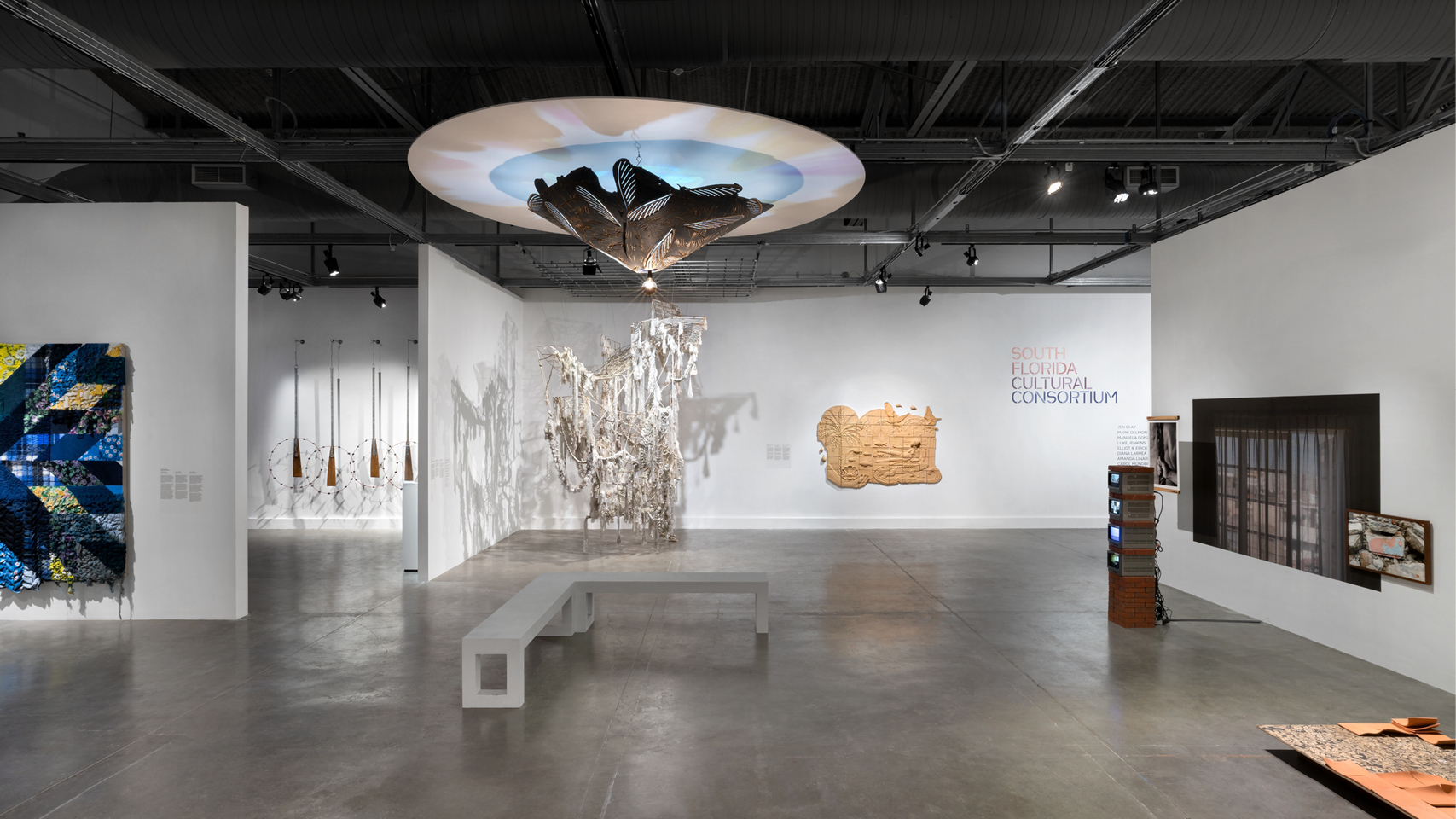
.jpg)


